
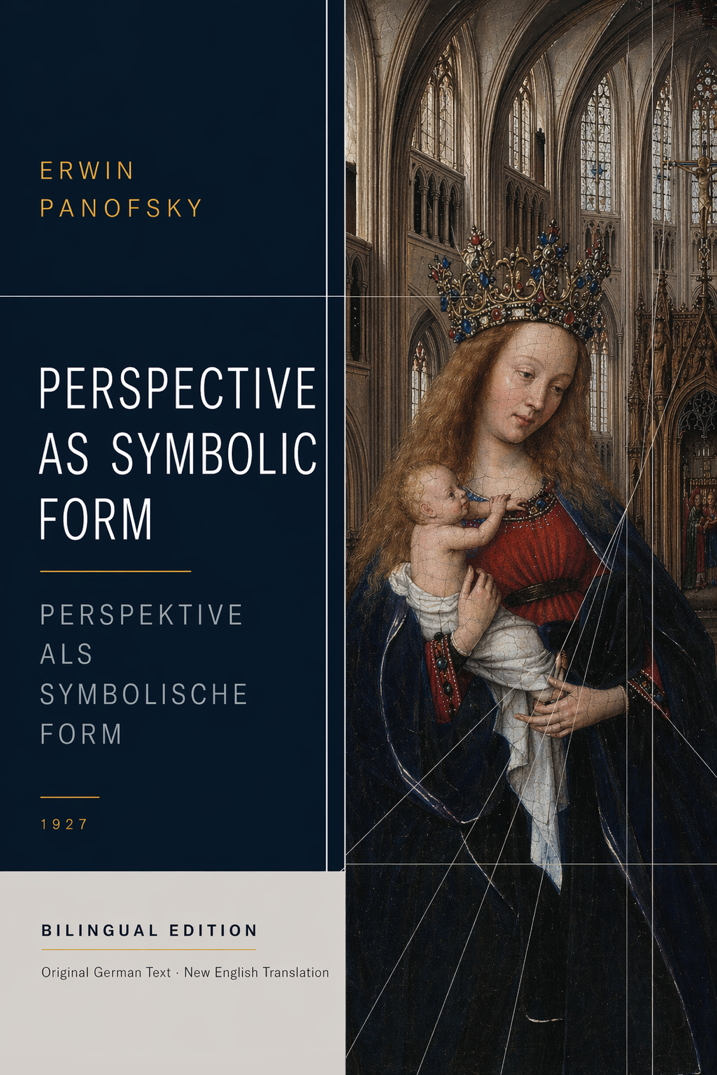
First published in 1927, Erwin Panofsky’s Die Perspektive als symbolische Form remains one of the most influential and challenging works in the history of art. Written at a formative moment in twentieth-century thought, the essay proposes a radical thesis: linear perspective is not merely a technical device for representing space, but a “symbolic form”—a historically specific way of structuring vision and understanding the world.
Ranging across classical antiquity, medieval art, and the Renaissance, Panofsky reinterprets perspective as an intellectual and cultural construct rather than a neutral mirror of visual reality. What appears as a naturalistic system of depiction emerges instead as an abstraction—one that organizes space into a homogeneous, infinite continuum and reflects a distinctly modern conception of knowledge and subjectivity.
Panofsky’s argument, deeply informed by the philosophy of Ernst Cassirer, transformed the study of perspective from a question of artistic technique into a central problem of cultural history. His essay continues to shape the field, standing as a lasting point of reference for debates on representation across art history, visual studies, philosophy, and critical theory.
This new edition presents the original German text alongside a fresh English translation, offering readers unprecedented access to Panofsky’s nuanced argument. It invites a return to a work whose richness, difficulty, and ambition have shaped generations of scholarship—and continue to challenge how we see, interpret, and situate images within history.