
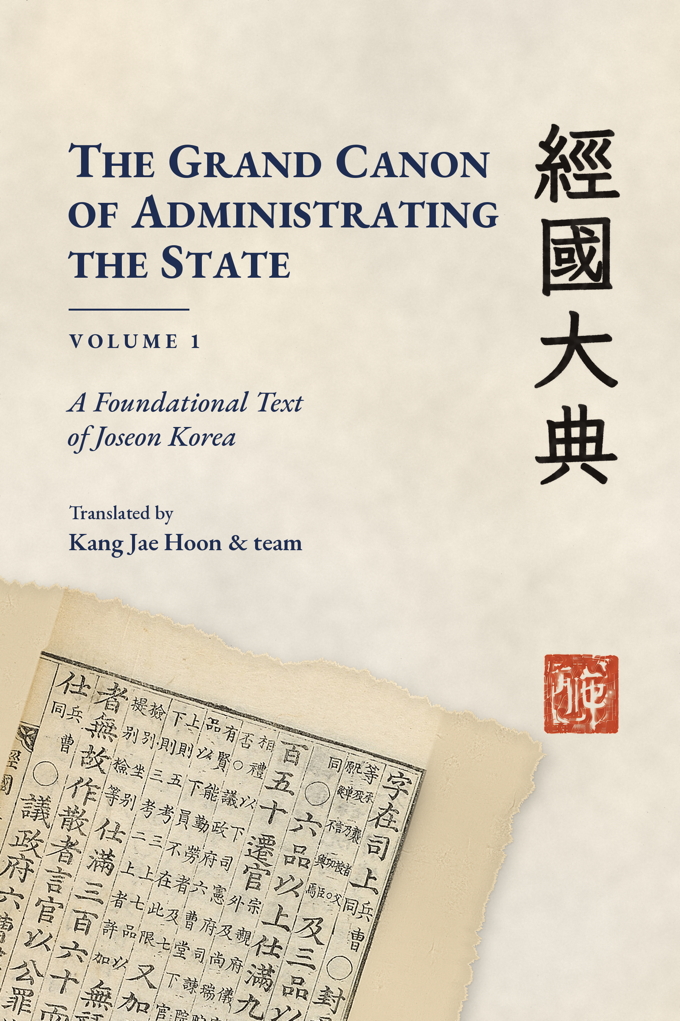
Presented here in English translation, The Grand Canon of Administrating the State (Gyeongguk daejeon, MR Kyŏngguk taejŏn 經國大典) provides direct access to one of the central documentary foundations for the study of premodern Korean government, law, institutions, and society. This edition is the result of an important translation project led by Professor Kang Jae Hoon (Korea University, Seoul), with support from the Ministry of Education of the Republic of Korea and the Academy of Korean Studies. It makes this major work of Joseon (MR Chosŏn) political and institutional history available to an international readership.
The Gyeongguk daejeon is one of the foundational texts of Joseon Korea (1392–1910). Compiled and repeatedly revised during the second half of the fifteenth century, it reached its definitive form in 1485 under King Seongjong (MR Sŏngjong, r. 1470–1495). From that point onward, it provided the basic legal and institutional framework for government during much of the Joseon period.
Its scope, however, extended far beyond what would today be understood as a collection of laws. The Gyeongguk daejeon set out the structure and operation of the Korean state in comprehensive form. Its six major sections correspond to the six central ministries—Personnel, Taxation, Rites, Military Affairs, Justice, and Public Works—and regulate matters ranging from official ranks, appointments, and local administration to taxation and finance, education and diplomacy, military organization, criminal justice, government buildings, transportation, and public works. In this sense, the work provides an unusually detailed view of how the political and administrative order of early Joseon Korea was conceived and organized.
That administrative order was inseparable from the Neo-Confucian political principles upon which the Joseon dynasty was built. The Gyeongguk daejeon defined the responsibilities of officials and institutions and helped establish a highly structured system of government in which royal authority operated through an elaborate bureaucracy and within an institutional framework of consultation, supervision, and remonstrance.
Its significance therefore extended far beyond the circumstances of its fifteenth-century compilation. Although later legal compilations supplemented and revised elements of the system, the institutional order established by the Grand Canon remained a fundamental point of reference throughout much of the Joseon period. The importance of the work lies not only in the individual regulations it contains, but also in the comprehensive vision of government, law, and political order that it embodied.